+86 88802688 ylj@gd-ylj.com ![]() +86 13670608306
 +86 13670608306

Views: 263 Author: Zora Publish Time: 2026-11-11 Origin: Site
Content Menu
● Aluminium vs uPVC Windows at a Glance
● What Are Aluminium and uPVC Windows?
>> Aluminium Windows: Extruded Profiles with Design Flexibility
>> uPVC Windows: Insulating Profiles for Residential Applications
● Aluminium vs uPVC Windows: The Detailed Comparison
>> Strength, Window Size, and Sightlines
>> Thermal Insulation and Energy Efficiency
>> Condensation and Indoor Comfort
>> Durability and Weather Exposure
>> Maintenance and Repairability
>> Appearance and Finish Options
>> Sound Insulation, Security, and Fire Requirements
● Aluminium vs uPVC Windows Cost: Compare Equivalent Quotations
● Three Expert Checks That Improve Window Procurement
>> 1. Create a Performance Evidence Matrix
>> 2. Match the Specification to the Exposure
>> 3. Approve a Sample Before Full Production
● Sustainability: Assess the Product, Not the Slogan
● How YLJ Aluminium Supports Project-Specific Decisions
● Which Window Material Should You Choose?
>> Are aluminium windows better than uPVC windows?
>> Are thermal-break aluminium windows as energy-efficient as uPVC?
>> Are aluminium windows suitable for coastal buildings?
>> Do uPVC windows always cost less?
Choosing between aluminium vs uPVC windows is not simply a decision between metal and plastic. It is a decision about structural requirements, thermal comfort, appearance, maintenance, and the performance your project can actually verify.
Aluminium generally suits slim sightlines, larger openings, and extensive finish customization. uPVC often suits standard residential windows where insulation and initial budget are priorities. Neither material automatically produces a better window.
At YLJ Aluminium, our manufacturing perspective starts with a practical principle: compare complete window systems, not isolated frame materials. The glass, seals, hardware, fabrication, and installation all influence the result.
This guide explains where each material performs well, where common comparisons become misleading, and what buyers should request before placing an order.

| Comparison factor | Aluminium windows | uPVC windows |
|---|---|---|
| Structural design | Well suited to slender profiles and demanding openings | Suitable for many residential openings; reinforcement may be necessary |
| Frame insulation | Requires careful thermal-break design for strong insulation | Naturally low-conductivity frame material |
| Appearance | Slim profiles and extensive finishing options | Often wider profiles; colors and decorative finishes are available |
| Initial cost | Often higher, especially for thermally broken systems | Often more economical for standard configurations |
| Maintenance | Routine cleaning, hardware care, and finish inspection | Routine cleaning, hardware care, and seal inspection |
| Weather performance | Depends on system design, finish, and installation | Depends on formulation, reinforcement, design, and installation |
| Environmental assessment | Consider recycled content, production impacts, and recovery | Consider production impacts and local recycling arrangements |
| Main purchasing priority | Verify complete-system performance | Verify complete-system performance |
These are general purchasing tendencies, not guaranteed product specifications.
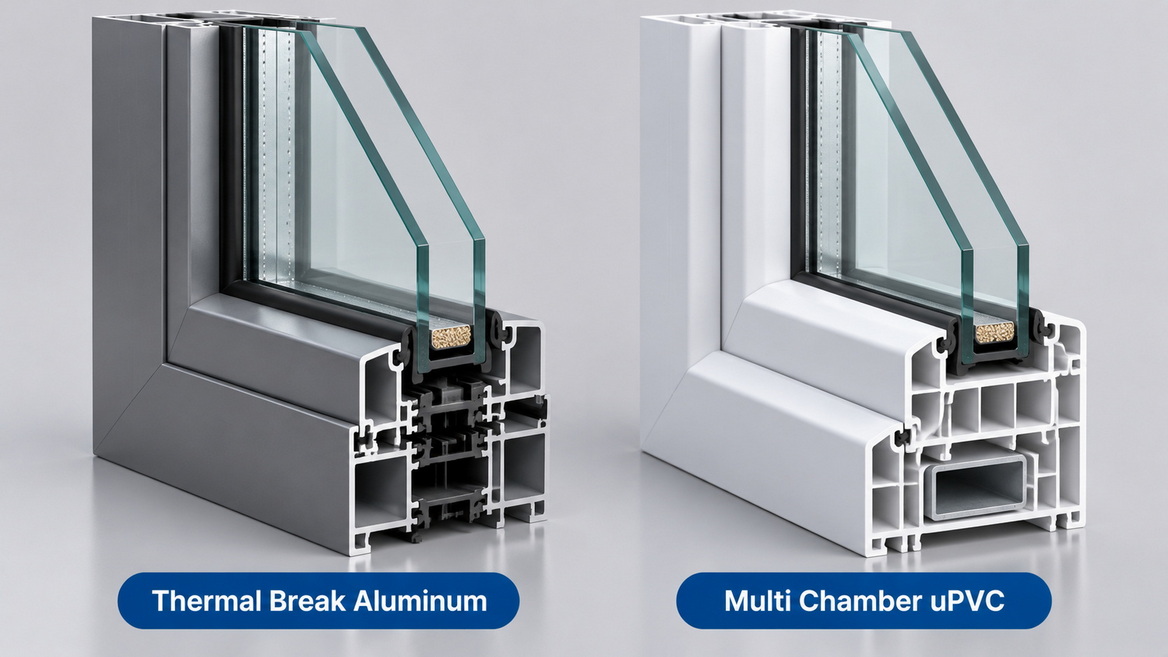
Aluminium window frames use extruded profiles that can incorporate drainage paths, hardware channels, glazing pockets, and thermal-break connections.
This manufacturing flexibility supports different opening styles and architectural details. However, aluminium conducts heat readily. An attractive frame without an effective thermal break can compromise comfort in temperature-controlled buildings.
uPVC means unplasticized polyvinyl chloride. It is a rigid plastic commonly used in window frames.
Its relatively low thermal conductivity helps limit heat transfer through the frame. Profiles often contain internal chambers, while some systems incorporate reinforcement to satisfy structural requirements.
The important distinction is between material properties and finished-window performance. A well-designed uPVC window can outperform a poorly specified aluminium window, and the reverse is equally possible.
Aluminium's structural characteristics make it attractive when architects want narrow frames or larger glazed openings.
Nevertheless, "aluminium supports larger windows" is not a substitute for engineering. Maximum dimensions depend on profile geometry, glass weight, opening type, hardware capacity, anchorage, and design wind pressure.
uPVC remains suitable for many residential windows. Larger configurations may require reinforcement or additional divisions.
My purchasing recommendation is straightforward: request approved size limits and structural documentation for the proposed configuration, not a generic statement about material strength.
uPVC has an inherent insulation advantage over unbroken aluminium. Thermally broken aluminium reduces heat transfer by separating interior and exterior metal sections with a less-conductive connection.
However, frame material alone cannot establish which window will save more energy.
Compare the whole-window U-factor, which describes heat transfer through the complete assembly. Lower values indicate less heat transfer under the stated rating conditions.
Also assess solar heat gain coefficient, or SHGC. It describes how much solar energy enters through the window. The appropriate value depends on climate, orientation, shading, and heating or cooling priorities.
Ask suppliers to identify the rating method, units, specimen dimensions, and glazing configuration. A glass-only value should never be presented as a whole-window result.
Neither aluminium nor uPVC guarantees condensation-free windows.
Condensation occurs when a surface becomes cold enough for moisture in the surrounding air to collect on it. Indoor humidity, ventilation, glass-edge temperature, frame design, and installation details all matter.
Thermal breaks and improved glazing can help keep interior surfaces warmer. However, replacing the frame material will not automatically resolve excessive indoor moisture.
For cold-climate projects, evaluate condensation performance alongside thermal insulation rather than treating it as a separate marketing promise.
Both materials can provide long service when correctly specified, fabricated, installed, and maintained.
Avoid treating widely repeated lifespan ranges as warranties. The frame, coating, insulated glass unit, gaskets, and operating hardware may have different service and replacement intervals.
Aluminium does not rust like steel, but it can corrode. Coastal exposure, unsuitable finishes, damaged surfaces, and contact with incompatible metals require attention.
uPVC performance depends on formulation, reinforcement, fabrication quality, and allowance for thermal movement. Color and solar exposure can also affect design requirements.
Specify exposure conditions first, then select a system supported for those conditions.
Both options generally require less routine finishing work than painted timber. Neither is maintenance-free.
A practical maintenance plan includes:
- Cleaning frames with manufacturer-approved products.
- Keeping drainage outlets unobstructed.
- Checking gaskets and perimeter seals.
- Lubricating hardware as instructed.
- Inspecting coatings, fixings, and exposed joints.
Repairability deserves attention before purchase. Ask whether hinges, rollers, handles, seals, and glazing components will remain available.
A durable frame offers limited value if a small proprietary component becomes impossible to replace.
Aluminium offers considerable flexibility in profile shape and surface treatment. Depending on the specification, options include anodizing, powder coating, PVDF coating, and wood-grain finishes.
uPVC also offers decorative options, including colored and wood-effect surfaces. It should not be dismissed as available only in white.
Compare physical samples and section drawings. Assess visible frame width, corner appearance, interior-to-exterior color coordination, and how the proposed windows align with adjoining façade elements.
There is no defensible universal acoustic winner based only on frame material.
Glass construction, seals, opening type, installation gaps, and the complete assembly affect sound reduction. Road-facing bedrooms may need a different specification from quiet courtyard rooms.
Security likewise depends on locks, hardware anchorage, glazing retention, and tested assembly performance.
Where fire performance is regulated, obtain documentation for the specific assembly and intended application. The frame material alone does not establish a fire-resistance rating.
uPVC often offers a lower initial price for standard residential windows. Aluminium often costs more, particularly with thermal breaks, specialist finishes, or demanding structural requirements.
However, a percentage premium without a location and specification can mislead buyers.
Two quotations are comparable only when they cover equivalent:
1. Dimensions, quantities, and opening styles.
2. Glass composition and thermal performance.
3. Hardware, screens, and accessories.
4. Air, water, and structural requirements.
5. Delivery, installation, taxes, and warranty scope.
Evaluate lifecycle cost separately from purchase price. Include installation, cleaning, likely component replacement, energy use, and eventual disposal or recovery.
Do not assume aluminium's higher initial price automatically produces better lifetime value. That conclusion requires project-specific evidence.
Before requesting quotations, prepare a short schedule identifying what must be demonstrated.
| Requirement | Evidence to request | Common comparison mistake |
|---|---|---|
| Thermal insulation | Whole-window rating for the specified configuration | Comparing glass-only and complete-window values |
| Wind resistance | Applicable test report or engineering assessment | Assuming every profile supports the same dimensions |
| Water resistance | Tested assembly details and installation requirements | Treating frame material as proof of watertightness |
| Sound insulation | Complete-window acoustic report | Comparing unrelated glass specifications |
| Finish durability | Defined coating system, exposure suitability, and warranty | Selecting by color name alone |
A test report is useful only when its scope applies to the proposed product. Check specimen size, opening type, glass, hardware, and permitted variations.
Consider three illustrative scenarios rather than assuming one material wins everywhere:
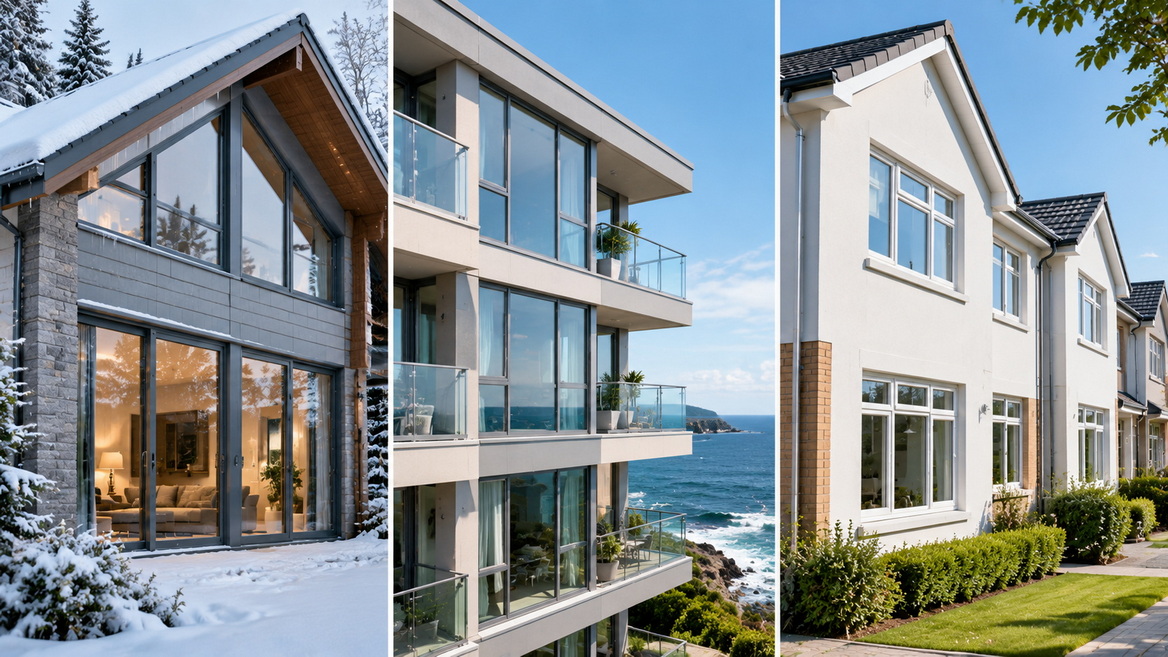
- A cold-climate home needs strong whole-window insulation, careful glass-edge design, and reliable installation.
- A coastal apartment needs appropriate finishes, compatible fixings, drainage, cleaning access, and verified wind and water performance.
- A budget housing development needs repeatable quality, practical maintenance, available replacement parts, and a compliant installed cost.
These are specification exercises, not claims about completed projects. Their value is showing how different priorities change the purchasing decision.
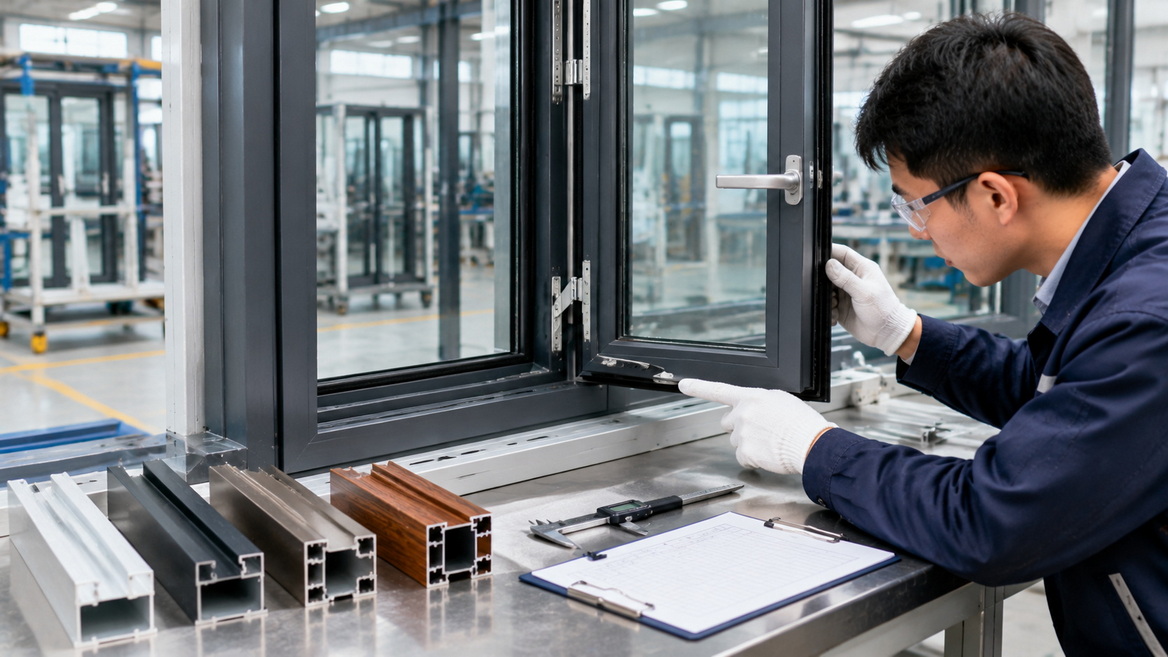
For a substantial order, review a representative sample or mock-up before authorizing production.
Check operation, finish consistency, corner quality, drainage details, glazing retention, hardware access, and packaging.
Where appropriate, agree inspection criteria and project-specific testing in advance. Resolve deviations before shipment rather than relying on expensive site corrections.
For international buyers, this step also helps clarify the boundary between supplied products and installation responsibilities.
Aluminium can be recovered and recycled, but recyclability alone does not prove that a particular window has a lower environmental impact.
Relevant factors include primary versus recycled material, manufacturing energy, coating processes, transport, operational performance, and end-of-life collection.
uPVC should not automatically be described as unrecyclable. Ask what recovery routes exist in the project's destination market.
Where available, compare product-specific environmental product declarations using compatible assessment boundaries. Also consider whether glazing, hardware, and seals can be replaced without discarding the entire frame.
A window that remains functional and repairable can avoid premature replacement, regardless of its frame material.
According to our company information, YLJ Aluminium was established in 1986 in Foshan, Guangdong, China. Our 200,000-square-meter manufacturing base operates 20 extrusion lines.
Our integrated capabilities cover melting and casting, extrusion, anodizing, electrophoretic coating, powder coating, PVDF coating, wood-grain transfer, and finished window and door processing.
Company-reported annual aluminium profile output exceeds 100,000 tonnes, while annual window, door, and curtain-wall production capacity exceeds 300,000 square meters.
This manufacturing scope supports coordination across profiles, finishes, and fabrication. It does not replace product-specific testing or destination-market compliance checks.
Our role is to translate project requirements into a proposed aluminium solution and identify the documentation needed to evaluate it.
Choose aluminium when slim sightlines, architectural customization, or demanding opening configurations are major priorities—and the proposed system meets the required performance.
Choose uPVC when standard residential configurations, frame insulation, and initial affordability are the main priorities—and structural and weather requirements are satisfied.
For either material, the strongest decision rests on verified performance, a complete quotation, and a credible installation plan.
For a project-specific aluminium proposal, send YLJ Aluminium your window schedule, drawings, project location, finish preferences, glazing requirements, and target performance. Request a quotation that clearly identifies the proposed system, supporting documentation, and supply scope.
Not universally. Aluminium often suits slim profiles and architectural flexibility. uPVC often suits economical residential applications. Compare the proposed systems against the same requirements.
They can be competitive, but results depend on the complete design. Compare whole-window thermal ratings for equivalent sizes, glazing, and opening styles.
Material alone cannot establish service life. Exposure, manufacturing quality, maintenance, installation, and replaceable components all influence how long a window remains serviceable.
They can be, provided the finish, pretreatment, fixings, drainage, maintenance plan, and complete system are appropriate for the exposure. Obtain written specifications and warranty conditions.
No. They are often less expensive in standard configurations, but premium glazing, reinforcement, hardware, finishes, and installation can change the comparison.
- U.S. Department of Energy — *National Best Practices Manual for Building High Performance Schools*. Supports the explanation of whole-window ratings, U-factor, SHGC, frame conductivity, thermal breaks, and the relationship between frames, spacers, and glazing. Its historical numerical examples are not used as current product benchmarks in this article. [energy]
- U.S. Department of Energy / Oak Ridge National Laboratory — *No-Regrets Remodeling*. Supports general discussion of aluminium and vinyl frames, thermal breaks, thermal movement, and maintenance. Its historical code statements are not used as current compliance guidance. [www1.eere.energy]
- QUALICOAT — Official architectural coating quality-assurance resource. Supports the importance of defined architectural coating specifications; it does not establish certification or coastal suitability for any YLJ Aluminium product. [qualicoat]
- HTS-ALU — *Aluminium vs uPVC Windows: Which Is Better for Your Project?* Used as the comparison-page starting point. Its generic lifespan ranges and material-wide performance figures have not been adopted as verified product data. [windoor.hts-alu]
- YLJ Aluminium — Company background supplied for this article. Source for establishment date, location, manufacturing area, extrusion lines, production figures, and process capabilities. These are company-provided statements, not independently audited figures; no public source page was supplied.


