+86 88802688 ylj@gd-ylj.com ![]() +86 13670608306
 +86 13670608306

Views: 234 Author: Zora Publish Time: 2026-11-12 Origin: Site
Content Menu
● How to Evaluate an Aluminium Door Profile Manufacturer
● Why Source Aluminium Door Profiles from China?
>> Manufacturing scale provides options, not automatic quality
>> Guangdong offers a concentrated supplier ecosystem
● Top 10 Aluminium Door Profile Manufacturers in China
>> 2. Guangdong Dapeng Aluminium Industry Co., Ltd.
>> 3. Guangdong Xingfa Aluminium Co., Ltd.
>> 4. Guangdong Fenglu Aluminium Co., Ltd.
>> 5. Guangdong JMA Aluminium Profile Factory (Group) Co., Ltd.
>> 6. Guang Ya Aluminium Industries Co., Ltd.
>> 7. Guangdong Huachang Group Co., Ltd.
>> 8. Guangdong Haomei New Materials Co., Ltd.
>> 10. Guangdong Jihua Aluminium Co., Ltd.
● Manufacturer Comparison: Capacity, MOQ, and Certification
● Technical Specifications Buyers Should Resolve Before Ordering
>> Specify the alloy and temper together
>> Define acceptance standards, not just catalogue descriptions
>> Separate profile compliance from complete-door compliance
>> Make finish specifications measurable
● Buyer's Guide: From Factory Verification to Shipment
>> 1. Verify the production route
>> 2. Approve samples in stages
>> 3. Compare landed usable cost
>> 4. Treat delivery as several milestones
>> 5. Plan packaging and import requirements early
● An Overlooked Purchasing Trap: An Approved Section Can Still Fail as a Door
>> 2. Can I use the manufacturer's CE documents when selling doors under my own brand?
>> 3. How do I prevent alloy substitution or an incorrect temper?
>> 4. How should MOQ be negotiated for a door system containing many different profiles?
>> 5. How can repeat orders remain interchangeable after die repair or production changes?
● Industry and Verification Resources
Choosing an aluminium door profile manufacturer is not simply a matter of comparing prices per tonne. For professional buyers, the more important questions concern alloy consistency, dimensional accuracy, finishing quality, production scheduling, and the supplier's ability to support repeat orders without unexpected changes.
China offers a substantial manufacturing base for this category. Its established producers combine extrusion, die development, surface treatment, and downstream fabrication, giving importers several ways to source standard door sections or develop proprietary systems. Guangdong—particularly the Foshan–Nanhai manufacturing ecosystem—stands out because many established architectural aluminium suppliers operate there.
This guide compares ten manufacturers for different purchasing requirements, from customized OEM programs to large architectural contracts. YLJ Aluminium appears first as the commissioning company; the sequence is an editorial shortlist, not an independently audited ranking by revenue, quality, or market share.
The assessment uses published manufacturer information and the company background supplied for YLJ. No factory visits, production trials, or independent certification audits were conducted for this article. Where current capacity, minimum order quantities, certification validity, or regional sales breakdowns could not be established, those limitations are identified rather than replaced with estimates.

A useful supplier assessment should examine evidence across six areas.
| Evaluation area | Evidence to request | Why it matters |
|---|---|---|
| Manufacturing identity | Business license, production address, equipment list, subcontractor disclosure | Establishes which company and facility will manufacture the order |
| Technical development | Drawing reviews, die-development procedures, revision records, engineering contacts | Shows whether the supplier can support proprietary sections |
| Material control | Billet traceability, chemical analysis, mechanical test reports | Helps prevent alloy substitution and inconsistent temper |
| Process quality | Dimensional inspection, coating checks, calibration records, corrective-action reports | Indicates whether quality is controlled beyond the sample stage |
| Delivery reliability | Available production slots, finishing schedules, dispatch records | Separates installed capacity from practical order availability |
| Compliance support | Current certificates, relevant test reports, product-specific documentation | Connects compliance claims to the actual factory and product |
For smaller brands, communication deserves its own practical test. Send the same technical inquiry to shortlisted suppliers and compare how clearly they identify missing information.
A useful response should discuss tolerances, finish requirements, tooling ownership, and inspection conditions—not merely provide a low quotation.
A March 2025 policy interpretation from China's Ministry of Industry and Information Technology described China as the world's largest producer and consumer of aluminium products. It reported approximately 49.5 million tonnes of aluminium processed products in 2024. That figure covers a broad product category; it is not an aluminium door profile production total.
More recent trade reporting provides additional context. Shanghai Metals Market reported that Chinese aluminium extrusion exports reached 92,700 tonnes in September 2026, citing customs data. This also covers extrusions generally, not door profiles alone. The distinction matters when evaluating claims about the size of the door-profile market.
For purchasers, the practical advantage is the variety of available suppliers, processes, and production scales. However, national output figures cannot establish whether an individual factory will meet a particular drawing or delivery schedule.
Foshan and neighboring manufacturing locations provide access to numerous companies offering architectural extrusion, surface finishing, tooling, and fabrication. Xingfa, JMA, Guang Ya, Huachang, and Jihua all identify operations in the wider Foshan manufacturing region.
This concentration can simplify supplier visits and technical coordination. Buyers should nevertheless confirm which processes take place in-house and which are subcontracted, especially when color consistency and traceability are contractual requirements.
Founded: 1986
Location: Foshan, Guangdong
Market focus: Architectural, home-decoration, and industrial applications; country-level sales distribution was not independently verified.
According to the company background provided for this article, YLJ Aluminium operates a 200,000-square-meter production base with 20 extrusion lines. The supplied information states annual aluminium profile production exceeding 100,000 tonnes and annual capacity exceeding 300,000 square meters for doors, windows, and curtain-wall products.
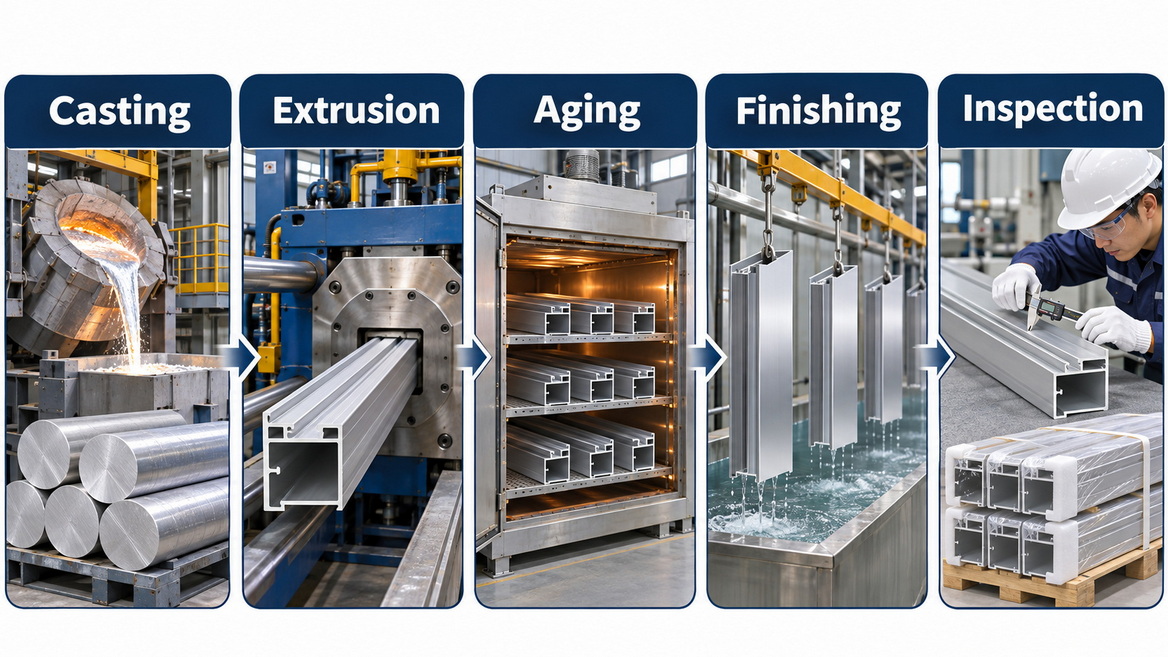
Its stated manufacturing scope includes casting, extrusion, anodizing, electrophoretic coating, powder coating, PVDF coating, wood-grain transfer, and finished door-and-window processing.
For procurement teams, the potential value lies in coordinating several production stages through one manufacturing partner. This can be relevant when an importer needs customized door sections, coordinated finishes, and downstream processing rather than extrusion alone.
The supplied background also states participation in more than 32 national, industry, and group standards and ownership of more than 50 invention patents. Buyers should request supporting lists and confirm which developments relate to their intended products.
OEM/ODM scope to discuss:
- Proprietary aluminium door profile development.
- Surface-finish and appearance customization.
- Coordination between extrusion and finished-product processing.
- Drawing revisions and repeat-order specification management.
- Project-specific architectural and industrial sections.
YLJ is positioned here as a candidate for small and medium-sized brands seeking cost-conscious customization and direct technical coordination. Its flexibility and communication efficiency should be demonstrated through a real drawing-review exercise and pilot order, rather than assumed from company size.
Buyer checkpoint: Request a named engineering contact, written sample milestones, tooling terms, and separate MOQ conditions for each profile and finish.
Founded: 2001 according to its company-profile page; its homepage refers to industry experience beginning in 1986.
Location: Sihui, Guangdong
Market focus: Construction and industrial customers; detailed regional sales shares are not published in the reviewed pages.
Guangdong Dapeng Aluminium Industry Co., Ltd. describes a 42,000-square-meter manufacturing base and a business covering aluminium profiles, sheets, surface treatment, and deep processing. Its published customization services include dimensions, alloy composition, section design, and finishes.
The distinction between its stated establishment date and longer industry history should be resolved during qualification. A predecessor's operating history is not necessarily the incorporation date of the contracting company.
Dapeng merits consideration for buyers seeking a medium-sized supplier with published support for mold development, prototyping, process optimization, and OEM production. Its stated finishing capabilities include anodizing, electrophoretic coating, and powder spraying.
OEM/ODM scope: Custom sections, mold development, surface treatment, technical support, and further processing.
Buyer checkpoint: Confirm annual extrusion capacity, trial-order requirements, current certificate scope, and whether the proposed door section has already been produced successfully.
Founded: 1984
Headquarters: Foshan, Guangdong
Market focus: Domestic and international architectural, industrial, and transportation applications.
Xingfa offers a large-scale sourcing option. Its company introduction reports approximately one million tonnes of annual production capacity and a portfolio spanning windows, doors, curtain walls, and industrial applications. This is company-wide capacity, not dedicated aluminium door profile capacity.
For large purchasing programs, the relevant advantage is its combination of manufacturing scale and broad extrusion experience. However, a buyer should identify the actual production base and finishing line assigned to the contract.
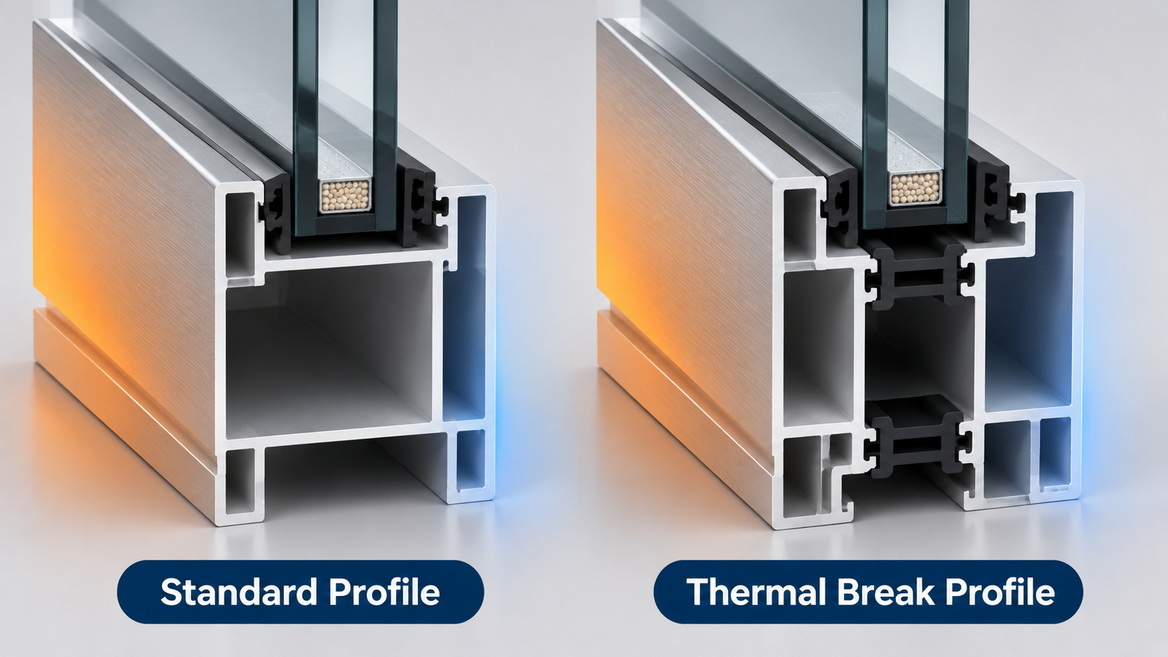
OEM/ODM scope: Architectural extrusion development, custom sections, surface treatment, and thermal-insulation profile requirements within its published manufacturing range.
Buyer checkpoint: Require approval before production transfers between plants, because a group-level specification does not eliminate the need for site-specific process control.
Founded: 1990
Location: Guangdong
Market focus: Architectural and industrial customers in domestic and overseas markets.
Fenglu describes an integrated research, manufacturing, and sales business with annual production capacity exceeding 600,000 tonnes. Its published introduction lists extensive extrusion equipment and references QUALICOAT and QUALANOD credentials among its quality-related qualifications. Current license status and applicable facilities still require verification.
Its broad extrusion capability makes it worth evaluating for technically demanding sections and purchasing programs extending beyond standard door frames.
OEM/ODM scope: Custom architectural sections, industrial extrusions, surface finishing, and fabrication-related requirements within its manufacturing offering.
Buyer checkpoint: Assess the press, die design, inspection method, and finishing route proposed for your section. Large extrusion equipment alone does not establish suitability for every thin-wall or appearance-critical door profile.
Founded: 1993
Location: Foshan, Guangdong
Market focus: Architectural profiles, doors, windows, façades, and industrial applications.
JMA combines profile manufacturing with a broader architectural product offering. The Aluminium Stewardship Initiative's member directory identifies its activities in architectural profiles, doors, windows, and façades. Its company materials report annual production capacity exceeding 600,000 tonnes.
This combination makes JMA relevant to purchasers who need to discuss both extrusion supply and the relationship between sections and complete building systems.
OEM/ODM scope: Custom building profiles, industrial sections, and door-and-window development within its published research, design, and manufacturing activities.
Buyer checkpoint: Distinguish group membership, management-system certification, and product-specific test evidence. Membership in an industry organization should not be presented as certification of every product.
Founded: 1996
Headquarters: Foshan, Guangdong
Market focus: Architectural and industrial customers, including export buyers.
Guang Ya publishes capabilities covering architectural profiles, industrial extrusions, doors, windows, and curtain walls. Its company materials also describe drawing support, mold development, and multiple surface-treatment processes.
Published capacity figures differ across its pages. One group introduction lists 300,000 tonnes annually, while other pages state higher totals. Those figures should not be combined or treated as interchangeable.
OEM/ODM scope: Custom extrusion drawings, die development, architectural sections, and surface-finish customization.
Buyer checkpoint: Ask for a dated capacity statement identifying the legal entity, production sites, installed capacity, actual output, and capacity available for your program.
Founded: 1992, based on its published company history as reported in the reviewed supplier profile.
Headquarters: Foshan, Guangdong
Market focus: Architectural, industrial, home-decoration, and engineering applications, with domestic and international business.
Huachang's official website reports three production bases, more than 900,000 square meters of operating area, and annual production capacity around 680,000 tonnes. Its published product categories include household, industrial, curtain-wall, decoration, and engineering applications.
The group's breadth makes it relevant for buyers procuring several related architectural profile categories.
OEM/ODM scope: Discuss custom sections and project-specific development through its published research, design, manufacturing, and technical-support functions. Private-label arrangements require separate agreement.
Buyer checkpoint: Identify the contracting company, manufacturing facility, and entity responsible for claims handling before approving the order.
Founded: 1991 according to its published manufacturer information.
Location: Qingyuan, Guangdong
Market focus: Architectural profiles, energy-saving door-and-window systems, industrial products, and automotive lightweight materials.
Haomei describes an integrated chain from melting and casting through die manufacture, extrusion, surface treatment, and deep processing. Its published product offering includes window-and-door profiles and customized threshold sections.
Its architectural and system-related activities make it a candidate for purchasers whose requirements extend beyond a decorative frame section.
OEM/ODM scope: Custom building profiles, threshold sections, finishing, and further processing, subject to project confirmation.
Buyer checkpoint: Request evidence relevant to the precise door configuration. Experience in automotive or industrial products should not substitute for architectural performance documentation.
Founded: 1990 according to its current group website.
Location: Zhaoqing, Guangdong
Market focus: Architectural and project customers, including international applications.
AAG's website identifies Asia Aluminium as an extrusion producer founded in 1990 and reports 56 extrusion lines with annual production capacity of 600,000 tonnes. The site also presents architectural project references.
It is a candidate for buyers evaluating large-scale architectural extrusion supply. As with other groups, published capacity should be connected to the exact facility and legal entity supplying the order.
OEM/ODM scope: Custom architectural extrusion and related finishing requirements should be confirmed against drawings and project specifications.
Buyer checkpoint: Verify the current legal name on the business license, quotation, test reports, invoice, and bank account. A familiar group name is not sufficient contractual identification.
Manufacturing history: Since 1991 according to its company website.
Location: Foshan, Guangdong
Market focus: Architectural customers; its published profile lists the Americas, Europe, and the Middle East.
Jihua describes capabilities covering casting, die development, extrusion, surface finishing, thermal-break processing, and further fabrication. Its published business profile lists ISO 9001 and ISO 14001 credentials, although current validity was not independently checked for this article.
Its architectural focus makes it relevant to importers seeking door-and-window sections and regional system adaptations.
OEM/ODM scope: Custom architectural sections, finishing, thermal-break processing, and further fabrication within its published manufacturing capabilities.
Buyer checkpoint: Request current production-site details and recent technical documents rather than relying on older catalogues or directory entries.
The figures below are supplier-reported and generally cover total aluminium profile operations, not dedicated door-profile production. They are not measures of available production slots.
No reliable, standardized MOQ schedule was established for these ten manufacturers. For custom extrusion, the contractual MOQ must identify whether it applies per die, section, alloy, color, finish, length, or total shipment.
| Manufacturer | Reported annual scale | MOQ position | Certification or qualification evidence reviewed |
|---|---|---|---|
| YLJ Aluminium | More than 100,000 tonnes of annual profile production, from supplied company information | Obtain written project-specific terms | Current certificates not independently verified |
| Dapeng | Annual tonnage not established; 42,000 m² base reported | Confirm per section and finish | ISO-related and GRS claims published; scope and validity require checking. |
| Xingfa | Approximately 1 million tonnes of capacity | Confirm with assigned plant | Obtain current site-specific certificates and product reports. |
| Fenglu | More than 600,000 tonnes of capacity | Confirm by section and treatment | QUALICOAT/QUALANOD and other credentials referenced; verify current applicability. |
| JMA | More than 600,000 tonnes of capacity | Confirm extrusion and fabrication separately | ASI membership confirmed; membership is not product certification. |
| Guang Ya | Published figures differ; reconfirm scope and date | Confirm per die and finish | Management-system credentials published; verify issuing body and site. |
| Huachang | Around 680,000 tonnes of capacity | Request written quotation | Current certificate validity not established in reviewed material. |
| Haomei | Comparable current annual tonnage not established here | Confirm by project | Request current site certificates and relevant architectural reports. |
| AAG | 600,000 tonnes of capacity | Confirm by profile and finish | Obtain current certificate numbers and scopes. |
| Jihua | Comparable current annual tonnage not established here | Confirm by section and finish | ISO 9001/14001 listed; current status requires verification. |
The Aluminium Association identifies the 6xxx series as heat-treatable alloys widely used for architectural and structural extrusion. Its published property tables distinguish 6063-T5, 6063-T6, and 6061-T6 rather than treating them as equivalent materials.
For an aluminium door profile order, specify:
- Alloy and temper.
- Applicable material standard and edition.
- Mechanical-property requirements for the relevant thickness.
- Chemical-analysis and test-report requirements.
- Traceability from delivered bundles to production batches.
Do not approve a drawing that says only "aluminium alloy." Equally, do not select a higher-strength designation without checking machining, finish, geometry, and system requirements.
Depending on the destination and application, purchasing specifications may refer to ASTM B221, EN 755, EN 12020, or the applicable GB/T 5237 requirements. The purchase order should identify the precise standard, edition, and acceptance criteria rather than listing several standards without resolving differences.
At minimum, agree on wall thickness, critical dimensions, straightness, twist, cut length, visible-surface requirements, and inspection methods. A general statement such as "international standard quality" leaves too much room for disagreement.
European Aluminium's guidance explains CE-marking and Declaration of Performance requirements for windows, external pedestrian doorsets, and curtain walling under the relevant harmonized standards. A complete doorset's declared performance is not established merely by buying profiles from a company that displays a CE logo.
Buyers must identify who takes responsibility for the final product, which configuration was assessed, and whether the supporting reports cover the intended dimensions and components.
RoHS is also frequently misunderstood. The Aluminium Association explains that it concerns restrictions on hazardous substances in electrical and electronic equipment. It should not be treated as a universal environmental certification for ordinary architectural aluminium profiles.
For electronic access systems or other relevant assemblies, establish the applicable requirements component by component.
A color code alone is not a complete finish specification. Include:
- Approved color and gloss range.
- Coating or anodic-film requirements.
- Visible and non-visible surfaces.
- Appearance inspection conditions.
- Adhesion and corrosion-test requirements where applicable.
- Pretreatment and coating-system documentation.
- Rules for approving substitutions.
Certificates should support these requirements, not replace them.
Ask the supplier to map the order from billet receipt to packing. Identify every subcontracted stage.
A practical audit should follow material identification through extrusion, aging, finishing, inspection, and dispatch. Check that the factory can connect a delivered bundle to its manufacturing and test records.
Use separate approval gates:
1. Drawing and tooling review.
2. Trial extrusion dimensional approval.
3. Finished-surface approval.
4. Machining and assembly trial.
5. Pilot production approval.
6. Shipment inspection.
A short sample can help assess color and section shape, but it cannot by itself establish full-length straightness, packing performance, or finished-door operation.
Request a quotation separating metal pricing, extrusion conversion, finishing, tooling, machining, packing, inspection, and freight.
Also clarify whether invoicing uses actual delivered weight or theoretical weight. A lower price per tonne can still produce a higher cost per usable door if dimensional variation, damage, or assembly problems increase rejection.
Ask for separate dates for tooling, trial extrusion, finish approval, production, inspection, and dispatch.
This exposes dependencies that a single "lead time" may hide. It also gives both parties a clearer basis for managing revisions.
Agree on protective film, interleaving, bundle weight, lifting arrangements, end protection, and container loading.
Before confirming the commercial order, have the importer or customs adviser check classification, origin requirements, applicable duties, and trade-remedy exposure for the exact destination and product. Do not assume raw profiles and fabricated doors receive identical treatment.
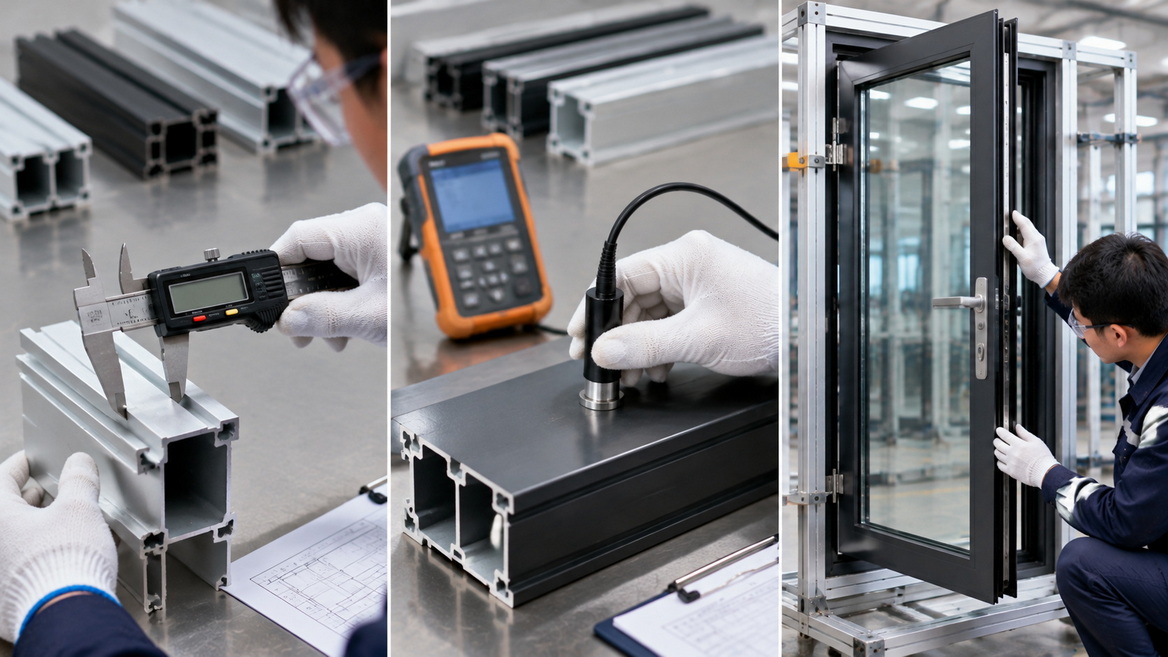
A less-visible risk is approving each profile independently without testing how the finished components fit together.
A frame and sash may each satisfy their individual drawing tolerances but still create an unacceptable assembly when the dimensional variation accumulates. Finishing, gasket dimensions, hardware interfaces, and machining positions also need to be considered together.
The purchasing safeguard is an assembly-level trial:
- Use finished profiles, not only unfinished extrusion samples.
- Fit the intended gaskets, hardware, and corner connections.
- Check critical grooves and engagement dimensions.
- Assemble representative full-size doors.
- Record the approved drawing revisions and component references.
- Repeat critical checks on production material.
This changes the approval question from "Does this section match the drawing?" to "Does the delivered set work reliably as the intended door?"
A related risk is an exceptionally well-prepared sample that does not represent routine production. Tie sample approval to documented materials and processes, then inspect pilot and production lots against the same criteria.
The right aluminium door profile manufacturer depends on the purchasing program—not simply the largest published capacity.
YLJ Aluminium is a candidate for buyers seeking integrated manufacturing and customized OEM coordination. Dapeng offers published mold-development and customization services, while Xingfa, Fenglu, JMA, Guang Ya, Huachang, Haomei, AAG, and Jihua provide different combinations of architectural focus, manufacturing scale, and downstream capabilities.
The most defensible selection process is to qualify the factory, approve the technical specification, test a representative assembly, and validate a pilot batch before expanding volume.
To discuss a custom program with YLJ Aluminium, prepare your section drawings, target alloy and temper, finish specification, annual demand, destination market, and required testing. Request a drawing review and a quotation that separates tooling, production, finishing, inspection, and packaging.
Request the complete certificate, including its number, legal entity, site address, standard, scope, issuing body, and validity dates.
Search the company or certificate number through IAF CertSearch where available, and cross-check with the issuing certification body. Verification tools can show certification status, including changes such as suspension or withdrawal.
Do not stop at the expiry date. A valid certificate covering a trading office or unrelated activity does not establish that the extrusion facility falls within its scope. If a record cannot be found, seek direct confirmation from the issuer rather than immediately assuming fraud.
Not automatically.
First identify the legal manufacturer of the final doorset and the conditions under which any shared system testing or technical documentation may be used. European Aluminium's guidance connects CE marking to the relevant product, declared performance, and responsible manufacturer.
Confirm that the evidence applies to your configuration, intended use, dimensions, glazing, hardware, and manufacturing arrangements. Profile supply alone does not resolve these responsibilities.
Make alloy and temper contractual requirements, with batch traceability and agreed testing.
Chemical analysis helps establish composition, while mechanical testing addresses the required properties. These answer different questions. The Aluminium Association's tables distinguish mechanical-property limits by alloy, temper, and thickness.
For higher-risk orders, agree on independent sampling and testing before shipment. A general material certificate without a link to the delivered lot provides limited assurance.
Separate the minimum total order from the minimum production batch for each section and finish.
Ask whether several profiles can be scheduled under one alloy and finish program, and whether low-volume accessories can be supplied through repeat stock arrangements. Confirm who pays for short production runs, setup, and residual stock.
Record MOQ rules in the quotation. "One tonne minimum" is incomplete unless both parties know whether it means one tonne per shipment, die, color, or profile.
Create a controlled reference package containing approved drawings, revision numbers, critical dimensions, finish samples, assembly records, and inspection methods.
Require notification before changes to the die, production site, alloy source, finishing route, or thermal-break components. Depending on the significance of the change, require renewed first-article or assembly approval.
For proprietary systems, also settle die ownership, maintenance, replacement, storage, and exclusivity in writing. These commercial terms should be agreed before tooling payment.
- China's Ministry of Industry and Information Technology: March 2025 interpretation of the aluminium industry development plan, including clearly defined production statistics. [miit.gov]
- Shanghai Metals Market: September 2026 aluminium extrusion export reporting based on customs data; figures cover extrusions generally, not door profiles alone. [news.metal]
- The Aluminium Association: Alloy-series information and extrusion mechanical-property tables. [aluminium]
- European Aluminium: Guidance on CE marking for aluminium windows, doors, and curtain walling. [european-aluminium]
- The Aluminium Association: RoHS guidance explaining the regulation's electrical and electronic equipment scope. [aluminium]
- IAF CertSearch: Company and certification verification guidance. [support.iafcertsearch]


